Far-Infrared Heating for Fruit and Food Drying Systems
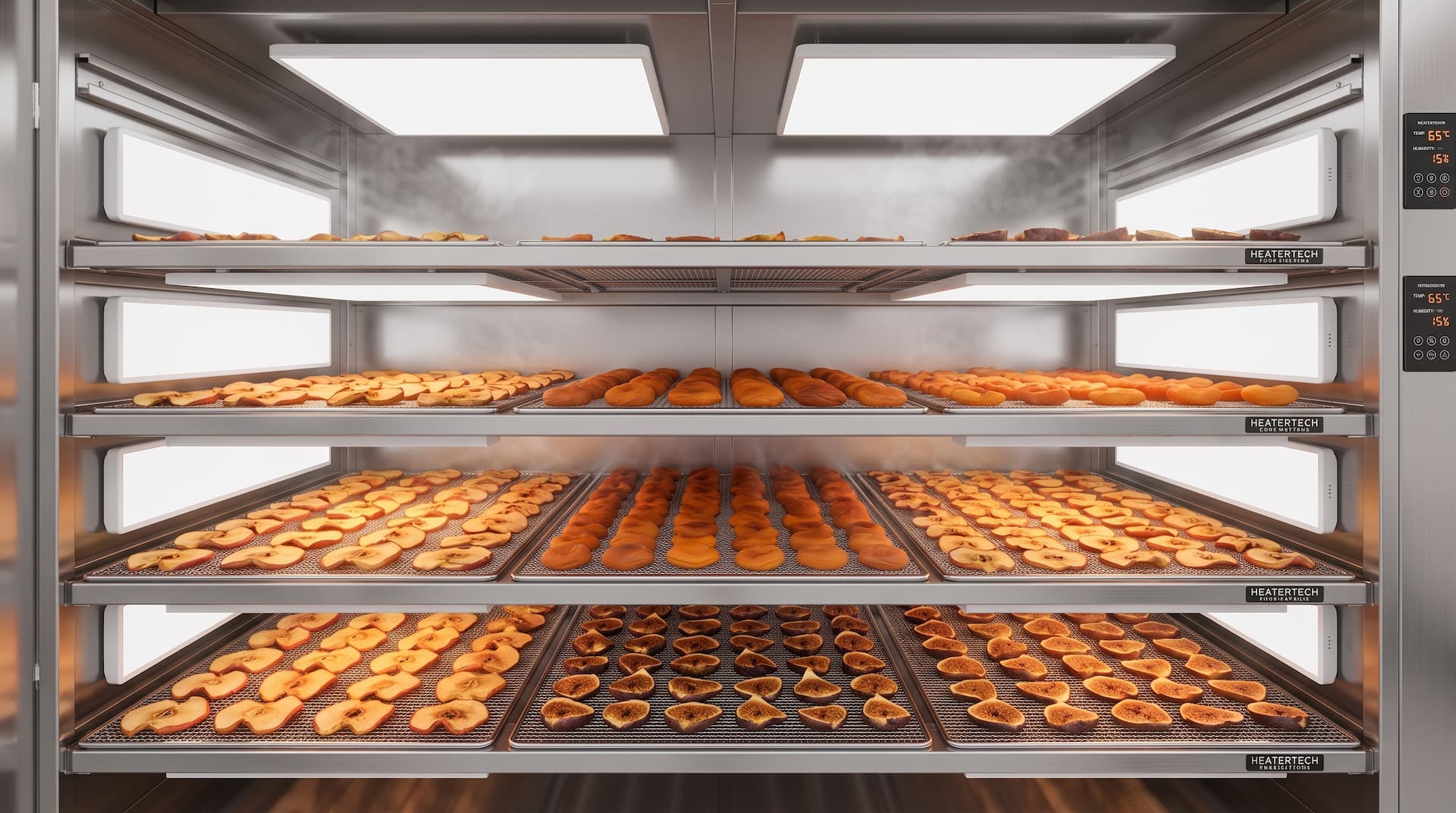
Direct Heat to the Product. Controlled Drying. Efficient Process.
In fruit and food drying processes, the goal isn't simply removing moisture from the product. It's also about preserving product quality, controlling drying time, and using energy as efficiently as possible.
Far-infrared (FIR) heating technology offers a different heating approach, transferring energy to the product via electromagnetic radiation.
In conventional systems, energy is usually transferred to the air first. With infrared heating, radiant energy reaches the product surface directly. This makes FIR technology worth evaluating especially for cabinet-type, shelf/tray, and custom-designed food drying systems.
The Importance of Heat Transfer in Food Drying
Drying food requires energy to evaporate the water inside the product. However, overheating the product can lead to undesirable effects on color, aroma, texture and overall product quality.
For this reason, a successful drying process needs to consider the following together:
- •Keeping the temperature under control
- •Transferring heat to the whole product as evenly as possible
- •Preventing overheating at the product surface
- •Removing the resulting moisture from the system
- •Setting the drying time according to process requirements
FIR heating brings a different, direct approach to the heat-transfer stage of this process.
How Does FIR Heating Technology Work?
Far-infrared heaters convert electrical energy into radiant heat energy.
The infrared energy emitted by the heater is absorbed by the product — at the right wavelength and under the right application conditions — and converted into heat.
Electrical energy → FIR heater → Infrared radiation → Product → Heat transfer → Moisture evaporation
This structure makes it possible to design systems where heat transfer doesn't rely solely on hot air coming into contact with the product.
For optimum results, however, FIR heating shouldn't be considered in isolation. Product temperature, air temperature, air speed, moisture extraction, product thickness, heater power, and the product-to-heater distance all need to be designed together.
Why FIR for Fruit and Food Drying?
- ✓
1. Direct Radiant Heat Transfer — One of FIR technology's most important features is that energy can be delivered radiantly to the product surface without relying on air as the carrier. This offers design flexibility that can be an advantage especially in drying systems where product is spread across shelves or trays.
- ✓
2. A Structure Suited to Precise Temperature Control — Different foods need different drying temperatures and durations. Apples, apricots, figs, grapes, tomatoes, peppers, mushrooms or spices can each require different process conditions. When paired with the right electronic control systems, FIR heaters can be integrated into different temperature and operating scenarios for different products.
- ✓
3. Compact System Design — The radiant heating principle allows heaters to be positioned close to the product and applied in different geometries depending on the drying cabinet's design. This means FIR heaters can be adapted to shelf dryers, tray dryers, cabinet-type drying machines, modular drying systems, and custom process machinery.
- ✓
4. Helps Optimize Energy Use — The core energy need in a drying system is evaporating the water inside the product. By delivering energy radiantly to the product, FIR heating can contribute to more effective heat transfer in well-designed processes. Actual energy performance depends not just on the heater, but on product type, drying capacity, airflow, insulation, moisture extraction, and the control algorithm. This is why FIR systems should always be evaluated together with the drying machine as a whole.
Which Foods Can Be Dried?
FIR heating technology can be designed for use across a range of food drying applications.
Fruits
- Apple
- Pear
- Apricot
- Fig
- Grape
- Banana
- Strawberry
- Orange and other citrus fruits
Vegetables
- Tomato
- Pepper
- Eggplant
- Carrot
- Onion
- Garlic
- Zucchini
Other food products
- Mushrooms
- Spices
- Aromatic plants
- Herbs
- Various plant-based products
- Foods with special drying processes
Since the ideal drying conditions differ for every product, process parameters need to be determined specifically for each one.
Controlled Drying at Low Temperature
Using a higher temperature in food drying doesn't always mean a better result.
Especially for fruits and vegetables, the temperature the product is exposed to is an important parameter for color, texture, aroma and process duration.
Many food drying applications work with temperatures roughly in the 40–70 °C range. However, this isn't a fixed standard — it varies by product type, initial moisture content, target moisture level, slice thickness, and drying method.
With appropriate temperature control, FIR systems can be integrated into controlled drying processes at low and medium temperatures.
FIR + Hot Air: Hybrid Drying Systems
One of the most important uses of FIR technology isn't replacing classic hot-air systems entirely — it's working alongside them.
In a hybrid system:
- •FIR heating → delivers radiant energy to the product
- •Hot air → carries away moisture from the product surface and controls ambient conditions
These two different mechanisms can be used together.
This approach can offer significant design advantages, especially in high-capacity drying systems or ones where process control matters most.
In a well-designed system, FIR heating, hot-air circulation, and moisture extraction work together as three complementary core elements.
The Heart of the Drying System: Proper Heat Distribution
One of the most common problems in drying cabinets is that not all product gets dried under the same conditions.
If product close to the heater dries faster while product further away dries more slowly, different moisture levels can form even within the same tray.
For this reason, in FIR systems the question "how many watts of heating do I need?" isn't enough on its own. The following also need to be considered together:
- •Heater placement
- •Product-to-heater distance
- •Radiation angle
- •Air circulation
- •Cabinet insulation
- •Moisture extraction
- •Temperature sensor placement
This approach is the foundation for a more even and repeatable drying process.
FIR Heating Solutions for Drying Machine Manufacturers
Our FIR heaters can be considered not just as a standalone heat source, but as a heating component to be integrated into the design of the drying machine itself.
Depending on the machine's capacity, cabinet dimensions and product type, the following can be determined for the application:
- •Heater power
- •Number of heaters
- •Panel layout
- •Distance between product and heater
- •Temperature control
- •Operating stages
This makes it possible to build a suitable heating infrastructure for applications ranging from small-scale drying machines to higher-capacity professional systems.
R&D and Custom Applications
No two food drying processes are the same.
Rather than applying an off-the-shelf heater to every system the same way, it's a better approach to determine a FIR heating solution that fits the specific product and machine design.
Especially if you're developing a new drying machine, heater power, panel layout, temperature control and air circulation can be considered together to develop the right solution for your system.
Let's Develop Your Drying Technology Together
Whether you're developing a new fruit and food drying machine, improving your existing system, or want to test a different heating technology, you can evaluate FIR technology based on your system's specific needs.
Share your product type, capacity, cabinet dimensions and target drying temperature — let's work together to evaluate the right FIR heating solution for your application.