Workshop and Warehouse Heating
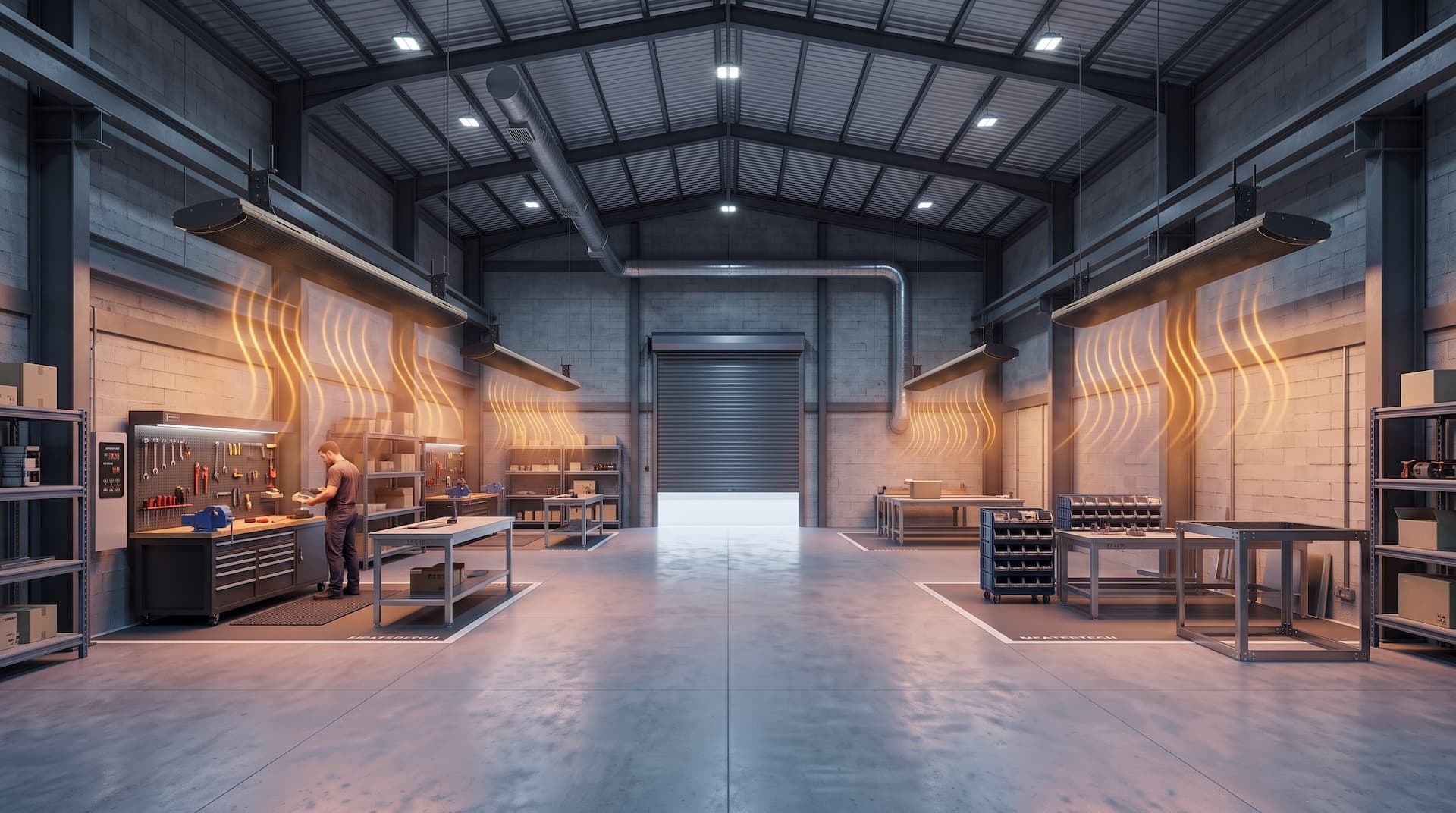
Heat the zones that need it — not the whole volume of your workspace
Workshops and warehouses are quite different from homes and offices when it comes to heating. Large floor areas, high ceilings, large doors, frequently opened entrances, distinct work zones, and variable operating hours all make choosing the right heating system critical.
Sunlike Tec's far-infrared heating solutions offer a different approach for spaces like these — instead of focusing on heating the ambient air, they directly heat the zones where people actually work and where heat is actually needed.
One of the key advantages of infrared heating is that it allows specific work areas to be heated separately, instead of bringing the entire building volume to the same temperature. This zonal heating approach can offer a significant advantage, especially in high-ceilinged or partially used workshops and warehouses.
No Two Workshops Use the Same Heater
Choosing a heater based on floor area alone isn't the right approach for a workshop or warehouse.
Within the space, several factors need to be considered:
- •Ceiling height
- •Insulation condition
- •Door and window openings
- •How often doors are used
- •Number of people working there
- •Location of work stations
- •Total area to be heated
- •Whether only specific zones or the whole space will be heated
- •Duration of use
- •Dust, humidity and other environmental conditions
— among others.
That's why, for workshop and warehouse applications, Sunlike Tec recommends evaluating different power levels and product types suited to the character of the space — rather than a single one-size-fits-all product.
Workshop and Warehouse Heating with the SL Series
Sunlike Tec's SL Series, available in 160 W, 320 W, 450 W, 640 W and 900 W options, can be considered for applications that need more controlled, local heating.
For example, in a small or medium-sized workshop, zones where people are constantly present — such as:
- •Work benches
- •Assembly tables
- •Technical service areas
- •Small production sections
- •Office or staff areas
- •Waiting and inspection points
— can be given zonal heating solutions with SL Series products.
Especially when the whole workshop isn't in constant use, heating only the work zone that's actually being used can lead to a more sensible system design.
Large Spaces with the Mid-Density Series
For larger workshops and warehouses with higher ceilings or wider work areas, the Mid-Density Series — available in 1000 W, 1800 W, 2400 W and 3200 W — can be considered.
These products stand out especially in applications that require creating larger radiant heating zones.
For example:
- •Large workshops
- •Production areas
- •High-ceilinged warehouses
- •Vehicle maintenance and service areas
- •Large assembly areas
- •Packaging areas
- •Loading and work zones
— can be planned for zonal heating with higher-power products.
In large-volume structures, the right solution is usually not heating all the air, but targeting the zones where people actually work. Factors like high ceilings, air movement, and frequently opened doors need to be considered carefully in the heating design.
Both Series Can Be Used Together
For some workshops and warehouses, the best solution isn't using just a single product group.
For example, in a large workshop, the main work areas can be heated with the Mid-Density Series, while smaller, constantly-used bench or staff zones can use the SL Series.
This makes it possible to create different power levels for zones with different needs.
What matters isn't choosing the highest-power heater — it's directing the right amount of heat to the right zones.
In industrial infrared applications too, product selection shouldn't be based on wattage alone — ceiling height, air movement, insulation, usage patterns, and the layout of the zones to be heated all need to be taken into account.
Infrared Heating in High-Ceilinged Workshops
In high-ceilinged spaces, heating the entire environment with conventional hot-air systems can become more difficult. Hot air rising, combined with the need to continuously heat a large air volume, can be a significant design problem — especially in partially used spaces.
With infrared systems, since radiant energy is delivered directly to surfaces, equipment and people within its line of sight, a zonal heating approach can be applied even in high-ceilinged spaces.
This makes it possible, for example, to heat only the packaging area where staff work in a warehouse, or only the zone with production benches in a workshop.
Zonal Heating for Workshops and Warehouses with Frequently Opened Doors
Large doors in workshops and warehouses being opened frequently throughout the day can pose a significant challenge for classic air-based heating systems.
In situations like this, instead of trying to keep the entire volume warm at all times, creating radiant heating in the zones where staff are present can be an alternative approach.
Heating specific zones — such as loading areas, service points, work benches and production stations — can make the system better suited to how the space is actually used.
Which Sunlike Tec Product Is Right for Your Workshop?
There's no single answer to this.
- ✓
A small, controlled work area? — The SL Series can be considered.
- ✓
A larger work area? — The Mid-Density Series can be considered.
- ✓
A large workshop with distinct work zones? — Both series can be used together.
- ✓
A high-ceilinged warehouse? — The Mid-Density Series, or multiple zonal heaters, can be planned based on mounting height and the location of the zones to be heated.
That's why at Sunlike Tec, we don't reduce product selection to just the question "how many square meters?"
Calculate Your Heating Needs
Consider your workshop or warehouse's floor area, ceiling height, insulation condition, usage pattern, and the zones you want to heat.
Sunlike Tec's AI-powered calculation module helps determine the right heating solution based on the information you provide.
Tell us about your space, and let's determine the right solution together.
Calculate My HeaterNote: Actual product selection and final heating capacity should be determined by evaluating the building's characteristics, environmental conditions, mounting method and usage scenario together.