How It Differs From Conventional Heating
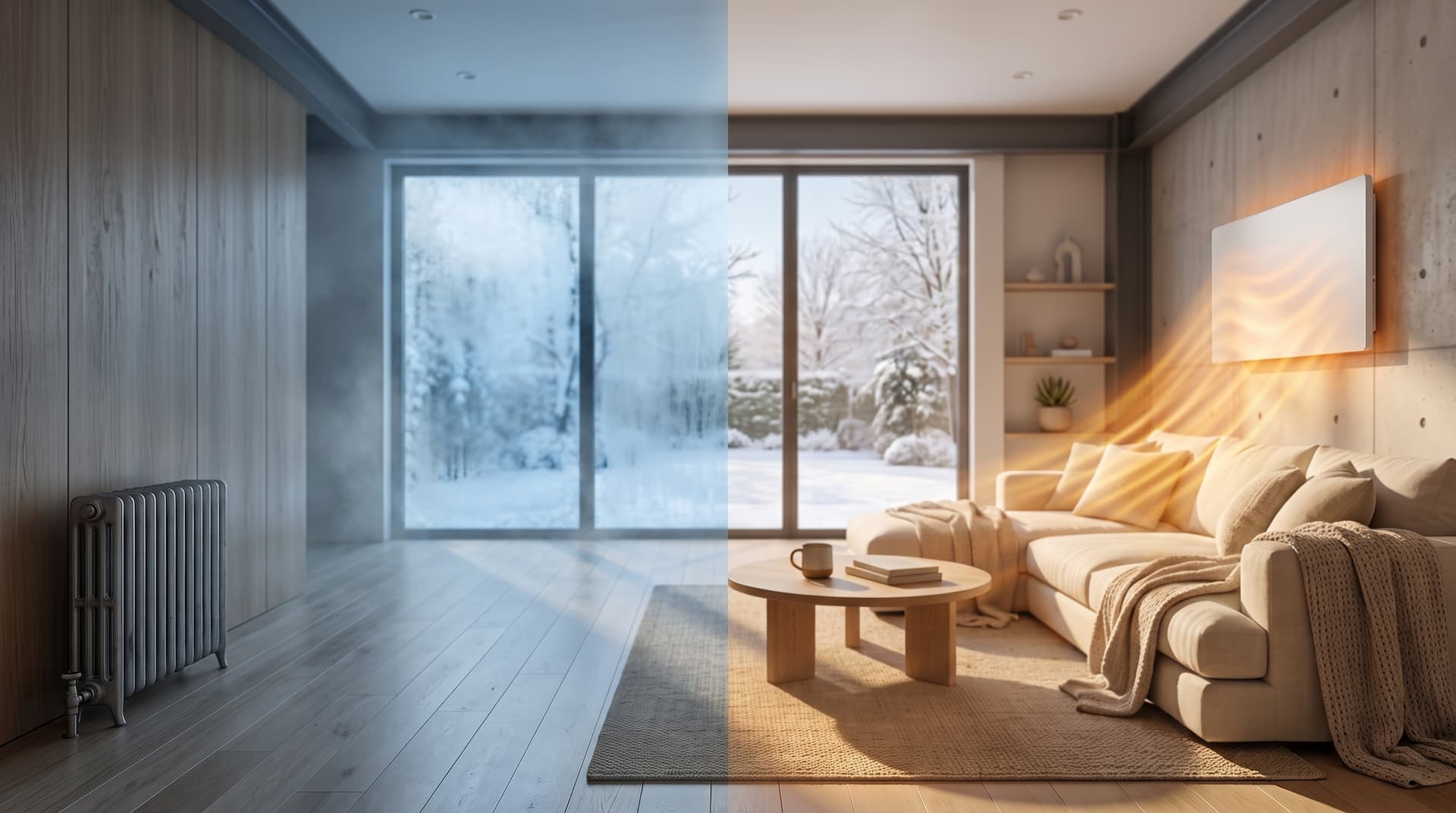
Hot Air Rises — Your Feet Stay Cold
Conventional systems — radiators, gas central heating, fan heaters — all work by heating the air. Warm air rises, collects near the ceiling, cools, sinks back down, and the cycle repeats endlessly. The result: the air near the ceiling is uncomfortably warm while the air at ankle height is still cool — the familiar 'hot head, cold feet' feeling. Infrared heating doesn't create that layering, because heat reaches surfaces and people directly — the temperature from floor to ceiling stays nearly even.
Conventional vs. Infrared: Where's the Difference?
- ✓
Dust and Allergens — Conventional systems constantly stir the air, lifting dust and allergens into it. Infrared heating creates no airflow, so dust largely stays put.
- ✓
Humidity, Condensation and Mould — Cold surfaces — windows and exterior walls especially — fog up when humid convection-heated air touches them, and mould follows over time. Because infrared heats those same surfaces directly, condensation doesn't form and humidity stays more balanced.
- ✓
Temperature Distribution — Conventional heating creates noticeable temperature gradients within a room. With infrared, floor-to-ceiling temperature stays nearly constant — which also means the same comfort can be reached at a lower thermostat setting.
- ✓
Noise and Draughts — Fan-driven systems generate noise and draughts while running. Infrared panels have no moving parts — they run silently, with no disruptive air movement.
- ✓
Maintenance — Unlike systems that need radiator bleeding, filter changes or periodic servicing, infrared panels need no regular maintenance.
Most of these differences also have direct consequences for health and energy use — we look at each of those separately in the next two sections.